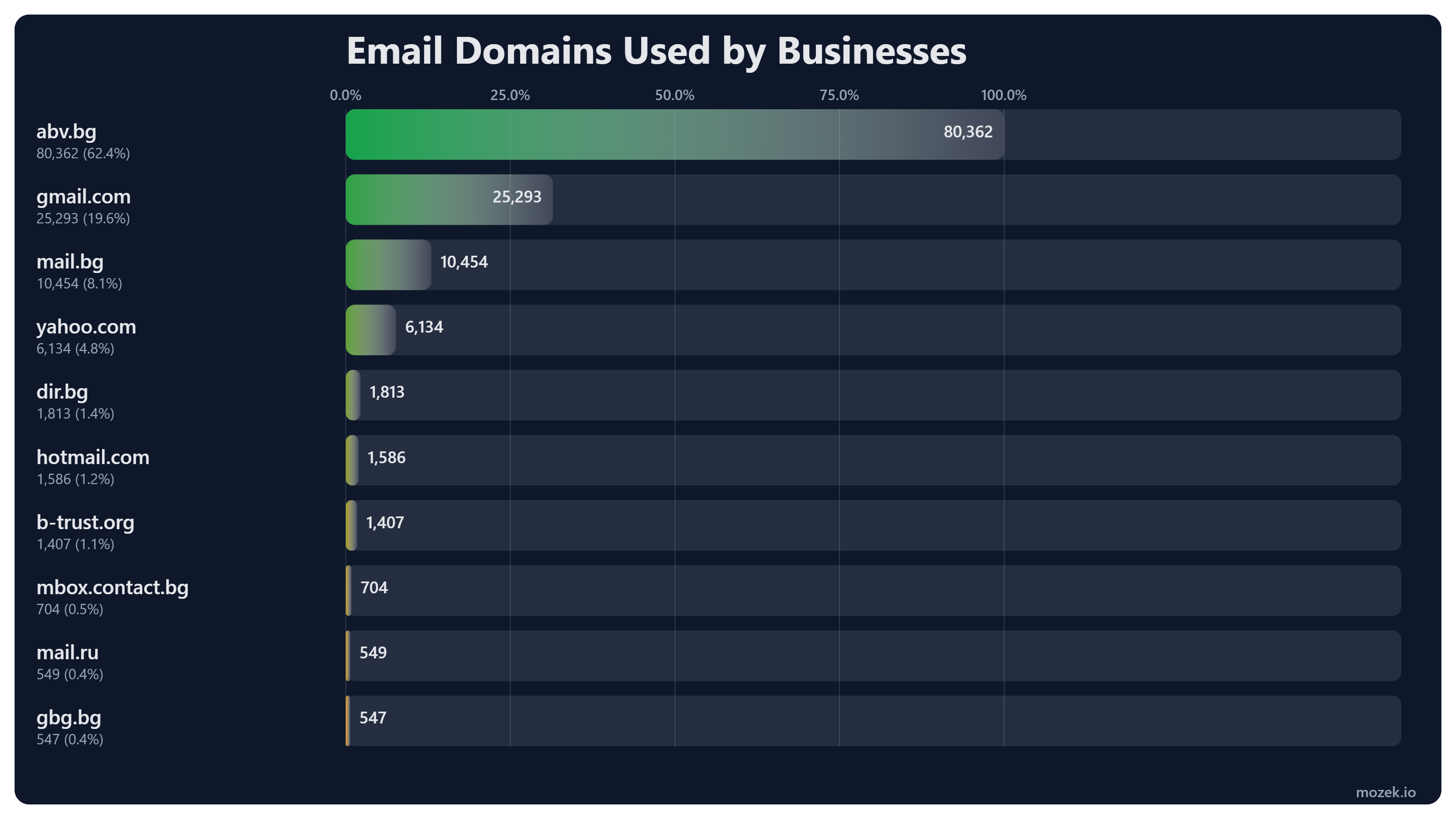
From a sample of 128,849 business email addresses, are on ABV.bg and on Gmail / Google Workspace . Local domains overall account for . That’s not just trivia — it’s a signal about digital maturity, deliverability, and buyer trust.
Why this matters for growth, CX, and security
-
Brand signal.
Replying from a free, consumer mailbox (
@abv.bg,@gmail.com) subtly says “micro-business.” A branded domain on your invoices, proposals, and support tickets is a trust multiplier. - Deliverability & authentication. Custom domains with properly configured DMARC, DKIM and SPF consistently land in inboxes, protect against spoofing, and give your security team something to monitor.
- SaaS & workflow integration. Sales, support, and billing tools integrate best with domain-branded mailboxes (routing, shared inboxes, SLAs, audit trails, and role-based access).
- Security posture. Modern stacks favor SSO, MFA and passkeys. With consumer inboxes it’s harder to enforce policies at the organization level.
Plausible reasons behind the pattern
- Historical inertia. ABV and other local providers have decades of mindshare. Many SMEs opened a mailbox years ago and simply never migrated.
- Cost sensitivity. “Free” feels safe in a low-margin environment — until one spoofed invoice or lost deal costs more than years of modern email hosting.
- Fragmented micro-firm landscape. Bulgaria’s SME structure skews small; domain-branded operations often come later in the growth curve.
- Data residency / sovereignty. Some firms prefer local providers and infrastructure. That can be a valid choice — but it can’t come at the expense of basic authentication and centralized governance.
What this statistic can’t tell us (yet)
This dataset is a directional snapshot — a strong hint, not a final verdict. We don’t see quality signals such as bounce rates, DMARC pass-through, phishing exposure, or conversion uplift by domain. For that, we’d need to combine this view with deliverability logs and CRM performance.
A 5-step upgrade path for Bulgarian SMEs
- Move primary communications to a domain-branded mailbox (e.g., Google Workspace / Microsoft 365). Keep legacy inboxes as forwards only.
-
Publish SPF, DKIM, DMARC (start with
p=quarantine, move top=reject) and monitor DMARC reports weekly. - Enable MFA for everyone and prefer passkeys where you can.
- Introduce a shared inbox for sales and support with SLAs, routing, and basic analytics. Tie it to your CRM, not to personal mailboxes.
-
Standardize “From:” identities (e.g.,
invoices@,support@) and archive everything centrally for compliance and audits.
Context: The EU’s Digital Decade strategy pushes for secure, interoperable digital services. Email is still the front door to your business. Treat it like a core system, not a free commodity.
Practical questions we hear from teams
“Do we have to migrate everything at once?”
No. Many teams start with new deals, invoices, and support tickets on the domain-branded mailbox while keeping legacy addresses as forwards for a few months. Once customers adapt, you can deprecate consumer accounts gracefully.
“Is Workspace / M365 overkill for a 3-person team?”
The monthly cost is often lower than the time you lose debugging bounced invoices or phishing incidents. Even very small teams benefit from centralization, MFA, and shared inboxes.
“Can we keep ABV.bg or Gmail for some functions?”
Yes — for internal newsletters, testing or non-critical flows. The key is that your primary business identity (offers, contracts, billing, support) uses a secure, controlled domain with clear ownership inside the organization.
Shareable one-liner
From a sample of 128,849 Bulgarian business inboxes, ABV.bg still dominates while Gmail trails; local domains rule the landscape — it’s time to upgrade email from “free mailbox” to a secure, domain-branded core system.
